Automotive & New Mobility
While automakers still produce more than 90 million vehicles each year – representing about 3% of global GDP – the automotive industry is in the middle of its biggest transformation since the assembly line. Traditional OEMs are racing to electrify their fleets while entirely new players, especially from China, are reshaping the mobility ecosystem. As a major customer for industries such as steel, electronics, and chemicals, the automotive industry's economic influence extends far beyond vehicle manufacturing itself. Yet transportation – closely tied to the automotive industry – ranks among the largest contributors to global CO₂ emissions. The shift toward electric vehicles (EVs), alternative propulsion systems, and new mobility models represents a crucial step toward cleaner and more sustainable transportation.
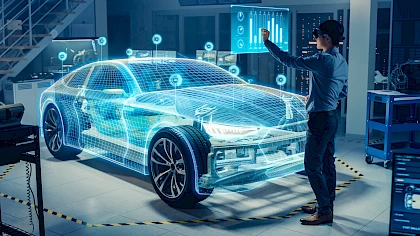
The industry landscape has evolved beyond traditional OEM and supplier models. Today it includes specialized EV battery suppliers, automotive software developers, and mobility service startups. The “New Mobility” paradigm – encompassing connected, autonomous, shared, and electric (CASE) transport modes – has the potential to significantly improve transportation efficiency, reduce emissions, and introduce new ownership models.
We provide tailored ad-hoc research, in-depth EV market intelligence, and custom studies to help clients navigate the rapidly evolving mobility landscape.
Our insights address critical industry questions such as:
- OEM electrification targets: What electrification targets have global OEMs committed to?
- Chinese EV disruption: How are emerging Chinese EV manufacturers disrupting the global passenger car market and what competitive threats do they pose to established brands?
- Autonomous driving & deployment: How close is the market to large-scale deployment of autonomous driving technologies, both in privately owned vehicles and in robotaxis, and what technical and regulatory barriers remain?
- New mobility services: Can new mobility services, such as ride-sharing and micromobility, significantly reduce emissions and private vehicle ownership?
- Urban mobility leadership: Which regions dominate the urban mobility market, and who are the leading players?
- EV battery supply chain: Who are the main suppliers of EV batteries to global OEMs? Which manufacturers are vertically integrating battery production at scale?
- EV incentives & subsidies: What government subsidies and incentives are accelerating EV production and consumer adoption across different regions?
- EV charging infrastructure: Where are the most developed electric vehicle charging infrastructure networks, and how are they evolving globally?