European Utilities Capacity Tracker 2025

IEA estimates that electricity demand in the EU will increase by about 300 TWh between 2025 and 2030. As electricity demand rises and the shift to renewables becomes more important due to decarbonization goals and recent geopolitical developments, KnowledgeAgent is launching the European Utilities Capacity Tracker to monitor how utilities’ generation portfolios are changing. The tracker summarizes the operational electricity generation capacity of ten major European utilities across renewable and conventional power sources. It highlights differences in renewable build-out, changes in conventional capacity, and shifts in generation portfolios across utilities. The first edition of the tracker focuses on power capacity changes between 2024 and 2025, highlighting renewable capacity additions by technology.

Analysis of selected utilities to highlight industry-wide developments

The capacity tracker provides a company-level view of how selected European utilities are reshaping their generation portfolios. Rather than focusing on overall European capacity trends, it shows how technologies are developing within individual companies over time. It enables peer comparison and helps quantify which companies are leading the renewable build-out, how quickly portfolios are changing, and how each utility compares with industry averages.

By tracking operational capacity instead of announced pipelines, the analysis focuses on realized assets rather than projects that may be delayed, resized, or cancelled. As a result, the tracker provides a more robust basis for understanding how utilities are transforming their generation fleets.

The ten analyzed utilities

The selected group of ten utilities from different countries in Northern, Southern and Central Europe has been chosen to provide a meaningful cross-section of the regional market. The tracker includes large players such as EDF, with an operational capacity of 126 GW, as well as smaller companies like Orsted and Fortum with around 10 GW each.

While the average renewables share of all companies is 58%, the tracker includes renewables-focused utilities such as Orsted, EDP and Iberdrola, as well as energy companies with more conventional portfolios, including EDF, Naturgy, Endesa and RWE. This mix makes it possible to compare very different starting points and shows that portfolio transformation is not following a single model across the sector.

Net capacity additions of 13 GW in 2025 among the 10 analyzed utilities

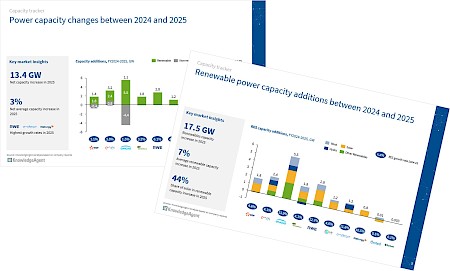
Among the ten companies, non-renewable capacity from nuclear, coal, and gas plants declined by around 4 GW, while renewable capacity increased by approximately 17 GW. Nearly half of these renewable additions came from solar, followed by wind at 25% and other renewable technologies such as biomass at 22%. At sample level, renewable build-out clearly outweighed reductions in conventional capacity, although the balance differed significantly by company.

These developments mirror broader changes in the European power system. In 2025, wind and solar together generated more electricity in the EU than fossil fuels for the first time. Solar capacity alone expanded by about 65 GW during the year, with new installations almost evenly split between large utility-scale projects and rooftop systems.

Power capacity changes between 2024 and 2025

Key findings for Enel, RWE and Engie

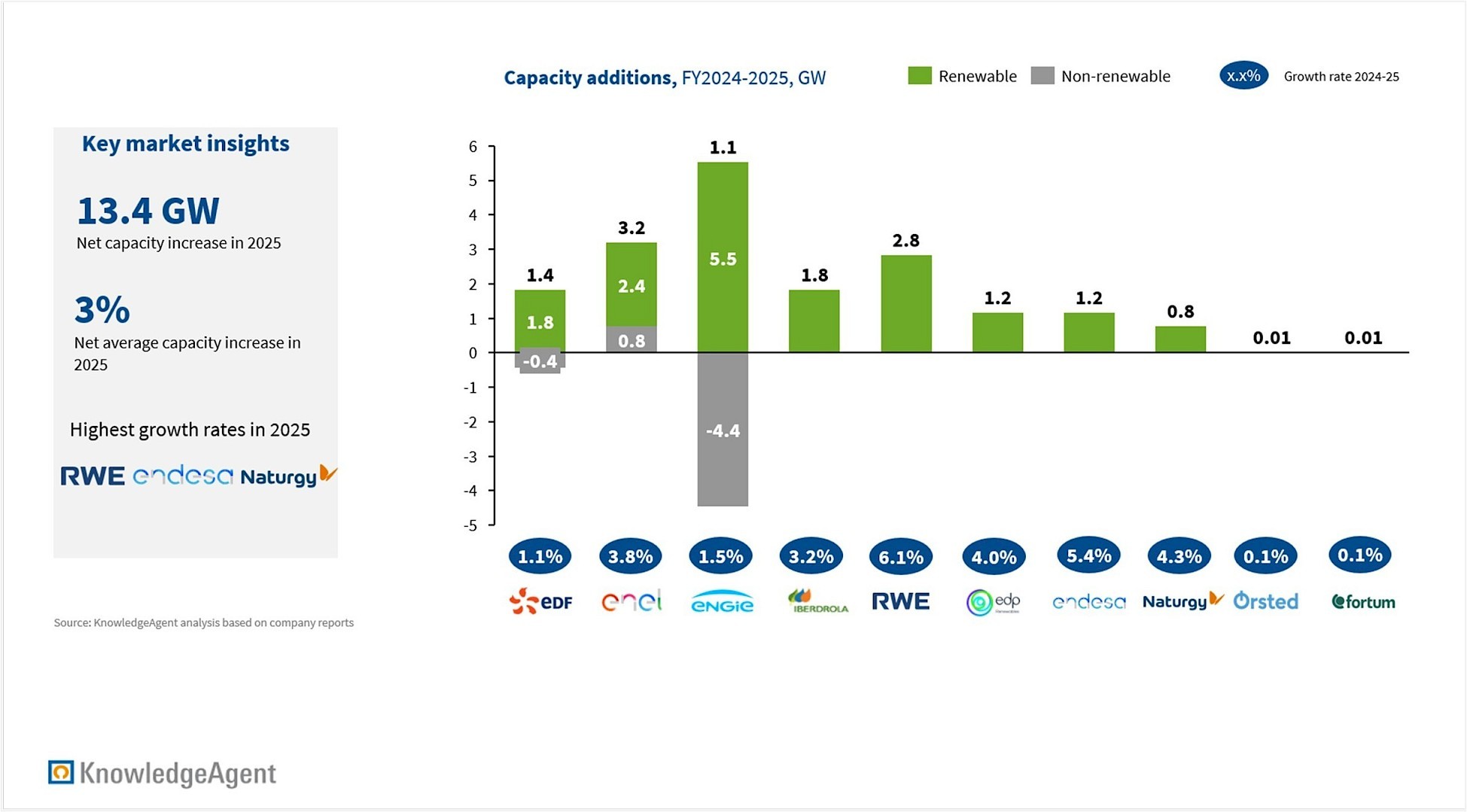
In 2025, the largest capacity shifts were observed at Enel, RWE, and Engie.

Together, these three examples illustrate different transition patterns: portfolio growth through renewables-led expansion, selective conventional additions, and transformation driven by both new low-carbon assets and conventional retirements.

Enel expanded its total generation capacity by 3.2 GW. Of this increase, 2.4 GW came from renewable energy assets, while 0.8 GW were added through non-renewable sources, primarily combined-cycle gas turbine (CCGT) plants in Italy. At Enel, portfolio expansion in 2025 included both renewable additions and selective new conventional capacity.

RWE reported a capacity increase of 2.8 GW, with renewables accounting for 99% of the additions. The company commissioned new solar and onshore wind assets across the United States and Europe during 2025. In RWE’s case, the shift is driven predominantly by renewable expansion, with very limited contribution from conventional technologies.

At Engie, renewable capacity grew by 5.5 GW through additions in battery storage, solar, wind, and hydropower. At the same time, the company reduced its conventional generation capacity by 4.4 GW. This decline resulted mainly from the phase-out of the nuclear units Doel 1, Doel 2, and Tihange 1 in Belgium, as well as reductions in natural gas-fired generation. At Engie, the scale of renewable additions coincided with a substantial reduction in conventional capacity.

Download the full report for a detailed view of capacity changes across the ten European utilities on the right-hand side. Request a meeting with our Electric Power & Utilities team to discuss your research projects in the energy field.

KnowledgeAgent offering beyond the capacity tracker

We apply our research method of systematically collecting, standardizing and validating asset- and company-level data not only to the capacity tracker but also to a range of complementary products such as:

  • Global and regional energy capacity overviews beyond individual companies, providing insights into entire geographies and broader market trends.
  • Capacity expansion goals tracking, including assets under construction and projects in the development pipeline to provide a clear view of the road ahead.
  • Company profiles that combine operational and financial indicators with assessments of strategy, project pipelines, and growth outlook.

Our offer supports market monitoring, competitor benchmarking and the evaluation of capacity additions across the energy sector.

More insights into the power sector can be found on our website:

  1. 10-2025: M&A analysis of solar and wind power projects
  2. 07-2025: Onshore wind energy supporting the green energy transition
  3. 06-2025: Heat pumps reshaping the global heating market

If you are interested in our offering, our team will be happy to explore how we can support you with an approach tailored to your needs.

Download

European Utilities Capacity Tracker 2025

Power capacity changes between 2024 and 2025 of ten selected European utilities

Download

Download

European Utilities Capacity Tracker 2025

Power capacity changes between 2024 and 2025 of ten selected European utilities

Download

// Tippy light border csshttps://unpkg.com/tippy.js@6.3.7/themes/light-border.css

This website uses cookies to ensure you get the best experience on our website. By continuing to use the website, you agree to the use of cookies. For more information about cookies, please visit ourprivacy policy.