Across industries, risk exposure is increasingly shaped by forces outside the organization: geopolitical tension, regulation, energy prices, trade fragmentation, sustainability requirements, and shifting supplier ecosystems. Many companies still rely on risk processes built for a more stable operating environment.
Established risk management processes remain essential. Supplier scorecards, compliance reviews, financial monitoring, and operational controls help organizations manage known and measurable risks. But they often fall short when external developments change the assumptions behind the risk model.
A strategic risk management approach strengthens established processes by adding structured external intelligence, scenario-based stress testing, and early warning indicators. The goal is to understand which external developments could materially change the organization’s exposure, how severe the impact could become, and which actions management should take before risks become visible in traditional indicators.
The case below shows how this approach strengthened supply chain risk management and supplier risk assessment in a globally exposed manufacturing company. In the case, scenario-based analysis identified hidden exposure across the supply base and supported mitigation actions, reducing severe disruption exposure by roughly 35-40%.
When Established Risk Processes Reach Their Limits
Many organizations have mature risk management frameworks in place. They regularly assess supplier performance, monitor financial health, review compliance, and track operational incidents. These processes are valuable, but they tend to focus on risks that are already known, measurable, or historically observed.
The challenge is that many critical risks do not originate inside the organization. They emerge from the external environment and only become visible internally once exposure has already increased.
A supplier may appear financially stable until energy costs, export restrictions, or localization requirements undermine its viability. A component group may seem low risk until trade fragmentation exposes dependencies created by single sourcing.
In these situations, historical indicators alone are no longer sufficient. Risk teams need a structured way to connect external uncertainty with internal exposure.
Where Market and Competitive Intelligence Creates Value
Strategic risk management depends on external intelligence. This is where market and competitive intelligence teams can contribute directly to enterprise resilience.
MI&CI teams already monitor many of the developments that shape future risk exposure, including market dynamics, competitor moves, regulatory changes, geopolitical developments, technology shifts, customer behavior, supplier ecosystems, and value chain dependencies. In many organizations, however, these insights are not systematically integrated into risk management processes.
The opportunity lies in turning external intelligence into decision-relevant risk inputs.
Case Example: Stress-Testing Supply Chain Resilience
The manufacturing company in this case relied heavily on cross-border sourcing. More than 65% of material spend came from international suppliers, and many critical components were sourced from single suppliers.
On paper, the company had an established risk management framework. Supplier assessments, financial monitoring, compliance reviews, and operational reporting were embedded in formal governance processes.
However, supplier risk evaluations focused mainly on historical performance and financial data. External developments such as regulatory tightening, trade fragmentation, energy price volatility, and industrial policy shifts were monitored, but not systematically translated into risk exposure.
This created a structural blind spot. While historical indicators suggested stability, the supply base showed significant hidden concentration:
- 41% of procurement spend concentrated in three countries
- 32% of critical components sourced from single suppliers
- 12 production sites dependent on a single logistics corridor
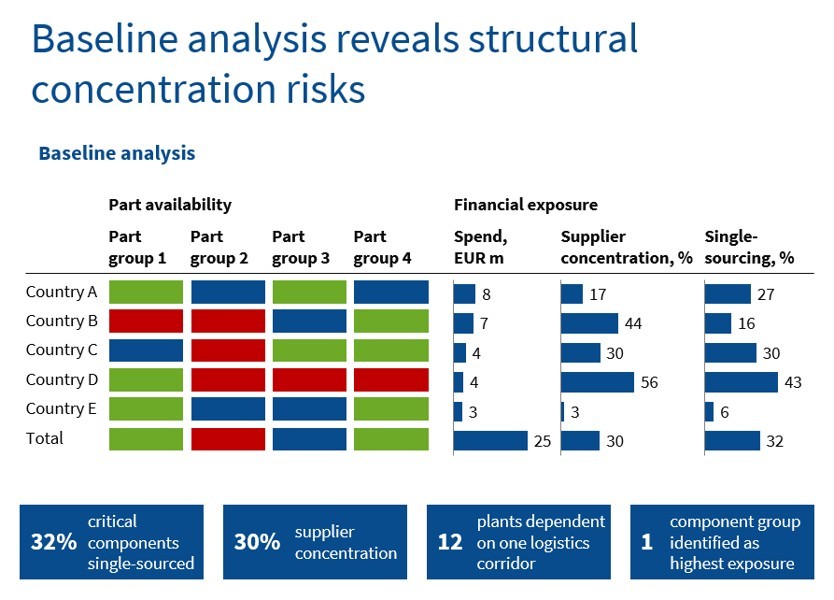
The core gap was the lack of a structured approach to translate external uncertainty into risk-relevant insights and to assess how supply chain risk could evolve under different conditions.
Where the Risks Came From
The risks in this case were derived from the interaction between internal exposure data and external risk drivers.
The analysis combined four types of input:
- Internal supply-chain data: supplier master data, procurement spend, country exposure, component criticality, single-source parts, production sites, logistics corridors, lead times
- External intelligence: trade policy, tariffs, export restrictions, energy prices, raw-material markets, regulation, sustainability requirements, geopolitical risk, labor constraints
- Scenario assumptions: trade fragmentation, resource access, energy price volatility, CO2 cost development, localization pressure
- Financial model inputs: revenue dependency, EBIT sensitivity, cost impact, lead-time impact, disruption severity
This broad information base and forward-looking perspective made the analysis fundamentally different from a conventional supplier review.
From External Signals to Supply Chain Scenarios
Strategic foresight was introduced as an extension of existing processes to assess how risks could evolve under different conditions.
In this context, strategic foresight served three functions:
- Structured identification of emerging external risk signals
- Scenario-based stress testing of the current supply chain
- Definition of leading indicators and escalation triggers
Foresight created a direct link between external uncertainty and operational risk exposure.
Identifying External Supply Chain Risk Signals
The first step was to identify external developments with potential impact on supplier viability and supply-chain resilience. These included geopolitical tensions, trade policy, energy security, regulation, raw-material availability, sustainability requirements, and labor constraints.
From these drivers, a set of critical uncertainties was defined, including:
- The degree of global trade fragmentation
- The pace of regulatory and sustainability requirements
- The persistence of elevated energy costs
These uncertainties formed the basis for four supply chain scenarios for 2035:
- Cooperative trade: stable trade environment with limited disruption; existing supplier structures remain broadly viable
- Fragmented blocs: tariff escalation and regional supply constraints increase supplier failure risk and localization pressure
- Green acceleration: rapid sustainability regulation and higher CO2 costs increase compliance costs and transformation pressure
- Resource nationalism: export restrictions and resource scarcity drive cost increases, supply shortages, and longer lead times
The scenarios were designed to challenge assumptions embedded in the existing supplier risk model.
Quantifying Supply Chain Risk Exposure Across Scenarios
The stress test produced materially different outcomes depending on the external environment. The results were based on modeled scenario analysis that combined internal supply chain data with externally derived assumptions on trade, regulation, and cost developments.
In a cooperative trade scenario, disruption remained limited, affecting less than 3% of revenue and reducing EBIT by 0.4 percentage points. This indicates that under stable external conditions, existing supplier structures remain largely resilient.
Under a resource nationalism scenario:
- Average inbound lead times increased by over 35 days
- Modeled revenue exposure reached ~17% of annual sales
- EBIT impact exceeded -4.1 percentage points
A fragmented trade scenario showed similar structural weaknesses, driven by tariff escalation and regional supply constraints.
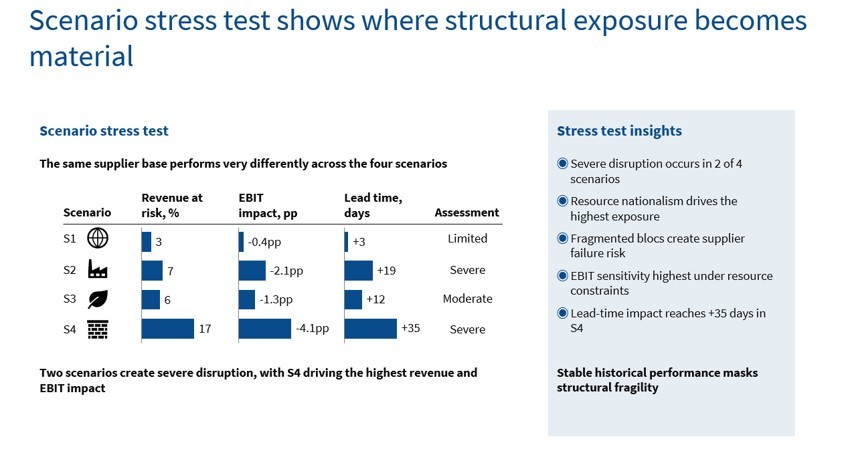
Overall, two of four scenarios resulted in severe and systemic supply chain disruption.
The central insight was that the supply chain became fragile when external developments interacted with structural dependencies inside the supply base.
New Risk Insights from the Scenario Analysis
One of the most important findings concerned a component group that had previously been classified as low supplier risk.
In the scenario analysis, this component group accounted for nearly 50% of total disruption exposure. It was the combination of single sourcing, geographic concentration, and exposure to trade and resource constraints that caused the issue.
The analysis also showed that financial exposure was highly sensitive to trade fragmentation, with tariff and localization effects amplifying cost impacts across the supply base. The practical implication is that risks that appear manageable under current conditions can become critical under alternative futures.
Taking Risk Management Action
The value of strategic risk management comes from translating scenario insights into decisions, indicators, and mitigation actions.
In this case, the scenario outputs were converted into tangible risk management actions.
First, the organization defined early warning indicators linked to the external drivers identified in the scenarios. These included tariff changes, material price indices, supplier risk scores, logistics delays, energy cost indices, regulatory developments, and geopolitical signals.
Second, indicators were connected to escalation thresholds. This allowed the organization to distinguish between normal volatility and developments that required management action.
Third, mitigation strategies were tailored to the way supplier failure could occur. In some cases, the appropriate response involved dual sourcing. In others, it required greater contractual flexibility, targeted supplier monitoring, inventory adjustments, logistics alternatives, or closer tracking of specific regulatory and cost developments.
Fourth, the outputs were embedded into ongoing risk dashboards and quarterly resilience reviews. This prevented the analysis from becoming a one-off strategy exercise.
As a result, modeled severe disruption exposure was reduced by approximately 35-40%.
Implications for Risk Leaders
Strengthening risk management in volatile environments requires a more systematic integration of external risk drivers into existing processes.
Key actions include:
- Systematically identifying and monitoring external risk drivers
- Defining leading indicators linked to these developments
- Integrating escalation triggers into existing governance structures
- Stress testing supply chain and supplier risk under alternative scenarios
- Aligning mitigation strategies with specific risk transmission mechanisms
Strategic foresight creates value when it is directly connected to these concrete risk management actions.
From Reactive Risk Management to Anticipatory Preparedness
The case illustrates how a strategic approach can strengthen risk management in a practical and business ready way. It provides a basis for assessing how external developments affect operational risk and for adapting mitigation strategies accordingly.
Risk management is evolving from static control to dynamic resilience. Established risk processes remain necessary, but they need to be complemented by external intelligence, scenario-based exposure analysis, and continuous monitoring.
Organizations operating in volatile environments should assess whether their current frameworks adequately capture external change and test resilience under different future conditions.
If you want to assess how external developments could impact your supply chain risk exposure, we can support you with tailored scenario analysis and risk modeling.